




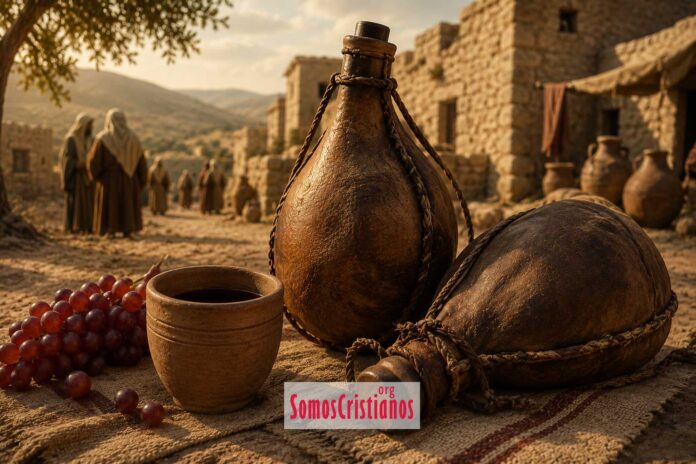
In Matthew 9:17, Jesus said:
“Neither do people pour new wine into old wineskins. Otherwise, the wineskins burst, the wine spills out, and the wineskins are ruined. No, they pour new wine into new wineskins, and both are preserved.”
In those days, wine was stored in containers made from animal skins called wineskins. When they were new, the leather was flexible and could stretch as the wine fermented. But over time, the leather would dry out, become hard, and lose its elasticity.
If someone poured new wine into an old wineskin, the fermentation would create pressure. Since the leather had already become rigid, it would eventually burst. The wine would be lost, and the container would be ruined as well.
For centuries, the people of Israel had lived under the Law given by God through Moses. The Law was good because it taught what was right and what was wrong. It revealed sin and helped people understand their need for God.
But the Law had a limitation.
It could point out the problem, but it could not change the human heart.
It was like a mirror that shows the dirt on your face but cannot wash it away.
Then Jesus came.
And with Him came something humanity had been waiting for through generations.
The Savior had arrived.
The promises of God were being fulfilled.
The New Covenant had come.
That is why Jesus said what we read in Matthew 5:17:
“Do not think that I have come to abolish the Law or the Prophets; I have not come to abolish them but to fulfill them.”
Jesus did not come to destroy the Law or to say that it was wrong. He came to fulfill the purpose for which the Law had been given.
The Law pointed to Him.
The sacrifices pointed to Him.
The prophecies pointed to Him.
Everything led to Christ.
It is important to understand something here. When Jesus spoke about new wine, He was not only talking about a new blessing or a new spiritual season. He was also announcing the New Covenant that God was establishing through Him.
For centuries, people had lived under the Law of Moses, which revealed sin and prepared the way for the coming Messiah. But when Christ came, He perfectly fulfilled everything the Law pointed toward. That is why salvation would no longer depend on keeping the Law, but on placing faith in Jesus Christ.
The Apostle Paul explained it clearly in Romans 6:14:
“For sin shall no longer be your master, because you are not under the law, but under grace.”
And later, in Romans 10:4, he wrote:
“Christ is the culmination of the law so that there may be righteousness for everyone who believes.”
This does not mean the Law was bad or that God made a mistake in giving it. It means the Law fulfilled its purpose of leading us to Christ.
The new wine was Jesus Himself, His grace, His forgiveness, and the new life He offered.
Many religious leaders could not accept Him because they tried to fit God’s work into their old traditions. They were old wineskins trying to contain new wine.
The problem was not the wine.
The problem was the container.
And although this teaching was given nearly two thousand years ago, it is still incredibly relevant today.
Because we too can become old wineskins.
We can attend church for years and still resist what God wants to do in our lives.
We can know many Bible verses and still refuse to forgive.
We can pray for change while holding on to old bitterness.
We can ask for a new life while clinging to old ways of thinking.
Sometimes we want God to change our circumstances, but not our hearts.
And many times God works on the container before He pours out the wine.
Before He pours out a new blessing, He transforms the heart.
Before He leads us into a new season, He renews the way we think.
Before He entrusts us with new responsibilities, He strengthens our character.
Because God does not simply want to give us something new.
He wants to make us new people.
That is why the most important question in this passage is not, “Where is the new wine?”
The real question is:
“Am I willing to become a new wineskin?”
Perhaps God wants to heal a wound you have carried for years.
Perhaps He wants to restore a broken relationship.
Perhaps He wants to draw you closer to Him.
Perhaps He wants to show you something about His love that you have never fully understood.
But in order to receive the new things God wants to do, we must first allow Him to renew our hearts.
The good news is that God is still doing exactly that.
He restores weary hearts.
He transforms broken lives.
He takes old wineskins and turns them into new vessels for His glory.
As the Lord promised in Ezekiel 36:26:
“I will give you a new heart and put a new spirit within you.”
I invite you to join me in this brief prayer:
Lord Jesus, thank You for coming to bring grace, forgiveness, and new life. Renew my heart, help me leave behind everything that pulls me away from You, and make me a vessel ready to receive Your work. In Your name, Amen.
Somos Cristianos, connecting hearts with Christ.