




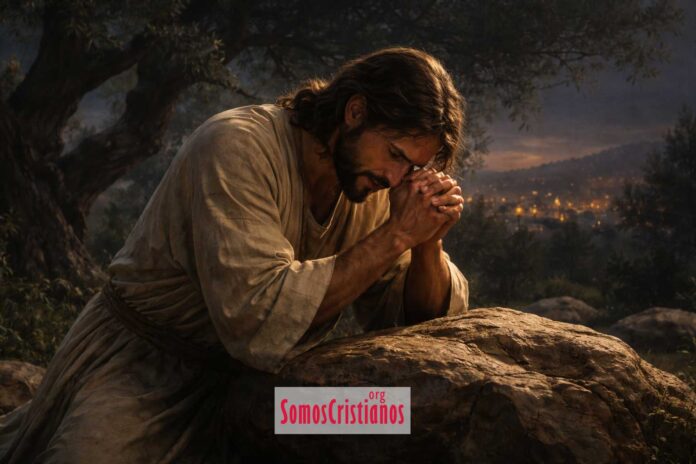
Pause for a moment and think about this: the Son of God—the one who calmed storms, healed the sick, and raised the dead—one night was trembling, distressed, and deeply sorrowful. Why did that happen?
The scene takes place in the Garden of Gethsemane, only a few hours before the crucifixion. Jesus knew exactly what was coming. It was not a surprise. He had already told His disciples several times what would happen. Yet when the moment arrived, something very profound took place in His heart.
The Gospel describes it this way:
“My soul is very sorrowful, even to death.”
— Matthew 26:38
It also says that He began to feel anguish and deep distress.
This has confused many people throughout history. Some ask: if Jesus is God… why did He feel fear? Why did He ask for the cup to pass from Him?
The answer reveals one of the deepest truths of Christianity.
Jesus did not come into the world merely to “appear” human. He truly became human.
He felt hunger.
He felt tiredness.
He felt pain.
And in Gethsemane He also felt anguish.
The Bible says:
“For we do not have a high priest who is unable to sympathize with our weaknesses, but one who in every respect has been tempted as we are, yet without sin.”
— Hebrews 4:15
That means something very powerful: Jesus understands our emotions because He experienced them as well.
When we feel anxiety… He understands.
When we feel fear… He knows what that feels like.
When pain feels overwhelming… He has already walked that path.
Gethsemane shows us the human side of the Savior.
When Jesus prayed, He said:
“My Father, if it be possible, let this cup pass from me; nevertheless, not as I will, but as you will.”
— Matthew 26:39
This “cup” was not only about death.
Jesus knew He was about to suffer torture, humiliation, abandonment, and a brutal death on the cross. But the heaviest part was not the physical pain.
The deepest weight was that He would carry the sin of the entire world.
The Bible says:
“He made Him who knew no sin to be sin for us.”
— 2 Corinthians 5:21
For the first time in history, the perfect Son would carry all the guilt, evil, and sin of humanity.
That meant experiencing something that had never happened before: the weight of sin and the separation it brings.
That is why His anguish was so deep.
In the Old Testament, the “cup” often represents judgment or the suffering someone must face. Passages like Isaiah 51:17, Jeremiah 25:15, and Psalm 75:8 speak of the “cup of God’s wrath,” referring to the punishment for sin. When Jesus in Gethsemane said “let this cup pass from me,” He was not speaking only about the pain of the cross. He knew He would carry the sin of the world and face the judgment that humanity deserved. That was the bitter cup He was willing to drink out of love.
Interestingly, a few hours earlier during the Last Supper, Jesus had taken a cup and said:
“This cup is the new covenant in my blood, which is poured out for you.”
— Luke 22:20
While the disciples were drinking that cup, which symbolized salvation and a new covenant with God, Jesus knew that in Gethsemane He would have to drink another cup: the cup of suffering and judgment for the sin of the world.
In other words, Christ accepted the bitter cup so that we could receive the cup of grace and forgiveness.
The Gospel of Luke adds a remarkable detail. It says that Jesus prayed with such intensity that:
“His sweat became like great drops of blood falling down to the ground.”
— Luke 22:44
There is even a rare medical condition called hematidrosis, in which a person under extreme stress can sweat blood.
Gethsemane was not a calm prayer. It was a deep spiritual battle.
There Jesus wrestled with the weight of what was coming… but He made a decision.
After praying, Jesus said:
“Not my will, but yours be done.”
That moment was decisive.
In Gethsemane Jesus chose to obey the Father even when the path was painful.
The cross was not the first place where our salvation was won. It began with obedience in Gethsemane.
There Jesus chose to move forward out of love.
Out of love for you.
Out of love for me.
Out of love for all humanity.
Many people think that feeling fear or anguish means a lack of faith. But Gethsemane teaches the opposite.
Jesus felt anguish… and still trusted God.
Faith does not mean the absence of fear. Faith means continuing to trust even when the heart trembles.
Jesus taught us that when the burden becomes too heavy, the right place to go is prayer.
Instead of running away… He prayed.
Instead of giving up… He surrendered to the Father.
And that changed the destiny of the world.
As for the disciples, they did not fall asleep out of indifference or disrespect. That night had been long: they had celebrated the Passover and heard Jesus speak about betrayal, suffering, and His departure. Sadness, confusion, and exhaustion overcame them. Luke 22:45 says they fell asleep “from sorrow,” revealing how fragile human beings can be even in the most important moments.
All of us have our own Gethsemanes.
Moments when we feel fear, anxiety, pressure, or deep sadness. Moments when we do not understand what God is allowing.
But when we remember Jesus in that garden, we understand something important: God is not far from our pain. He Himself walked through that valley.
And if Jesus overcame anguish by trusting the Father, we too can learn to say:
“Lord, I do not understand everything… but I trust You.”
Let this reflection stay in your heart.
Jesus was not weak in Gethsemane. He was deeply human… and at the same time perfectly obedient.
There the path began that would lead to the cross… and three days later to the resurrection.
I invite you to join me in this prayer:
Lord Jesus, thank You because in Gethsemane You showed us that You understand our struggles, our fears, and our anguish. Thank You because You did not abandon the path of the cross, but obeyed the Father out of love for us. Help us to trust You when life becomes difficult. Teach us to seek You in prayer and to rest in Your will. Amen.
Somos Cristianos, connecting hearts with Christ.